
Our Need and Our Moment
This teaching is Session 2 from our Men’s Retreat on September 20, 2025. Audio is available upon request.
This morning, in application of last night’s talk, I want to call each of you to do three things:
Recover your name
Redeem your wounds
Rise to the moment
1. Recover your name
This is going to sound obvious, but I’m gonna say it: a man must know his name.
Let me qualify this two ways:
When I say “name” I don’t simply mean your name, but what your name means … what you’re about. It’s what you wrote down last night after you said “My name is [fill in the blank].”
And when I say “know” I don’t mean simply know it, but really know it. Embrace it, on the front side of your doing, not as a result. You start with you who you are, and do from that, not for that.
I’m convinced within our families, as dads, this is one of the greatest gifts we could give our sons.
An Identity to Work From
Earlier this year, my oldest son, Micah, dislocated his left elbow, his pitching arm, playing basketball. It put him way behind for baseball. Time he could have spent strength training he spent rehabbing his arm, and he missed a lot of school for his appointments, and he just got buried. The report card was not good. But there was a stretch of intense discouragement. He thought he had ruined his whole year and he wanted to give up.
So we met in his room, April 7 (in my journal), and he’s in the pit, and I showed him one of my dad’s work hats, “Parnell & Son Drywall.” That’s the family business my granddad and dad started in 1985 — I explained that to him — and then I told him about my great-grandfather who was a farmer in North Carolina — and I said:
Look, there’s not a single perfect man in your family tree, but one amazing thing about our fathers was that they worked hard. They weren’t afraid to sweat, ache, or bleed. And that’s part of your heritage.
And I said:
Look, I love you no matter what. You don’t have to excel in anything, but even if you flunk science or never play any ball again, it will not be because you didn’t work hard, because hard work is in your blood.
And you know what he did? He picked his head up and he said, I’ll do it. He dialed in. I gave him an identity to work from, not to. And that’s basically how I understand fatherhood. That’s the main thing I’m trying to do as a dad to my boys. I want my sons to know their name.
Forsaking the False Self
But first we gotta know ours. And what if we didn’t have those moments when we were 14? Some of us have never had those moments. Some of us have never had our father, or a father-figure, look us in the face and tell us we’re men, and that we’re loved, and that we’re worth it. Or maybe they did and we just couldn’t believe them.
And so we chase it. We run the play, Do-Have-Become. We do whatever we gotta do to find the validation we crave as men. And this is where we construct the False Self, which we talked about last night. Many of us live for this False Self, which is why embracing our name is a recovery project. We have to forsake the False Self to get to who we truly are, and in order to do this, we need to know more about this False Self.
I said last night that the False Self is what we call the thing we construct with Do-Have-Become. It’s what we’re building toward with all our wound-led work.
Last night we saw the two ways to go about it:
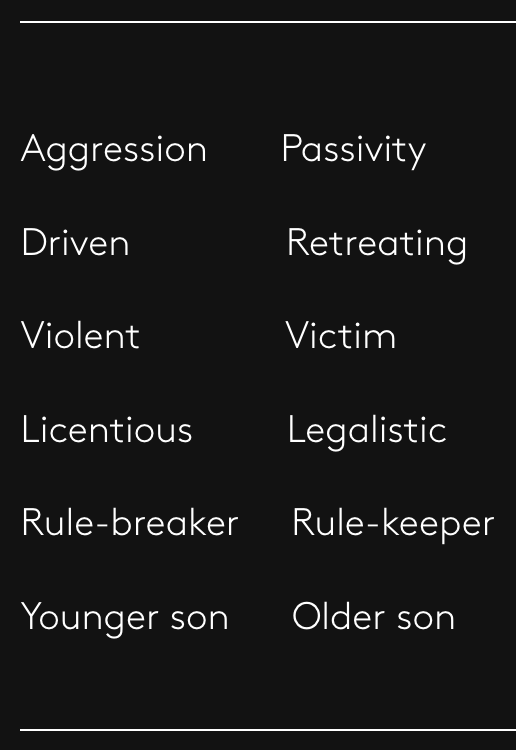
Back to Luke 15
We looked at the pathway of the younger son, this morning I want us to look at the older son.
Pick up reading in verse 22, the father’s response to the younger son …
“But the father said to his servants, ‘Bring quickly the best robe, and put it on him, and put a ring on his hand, and shoes on his feet. 23 And bring the fattened calf and kill it, and let us eat and celebrate. 24 For this my son was dead, and is alive again; he was lost, and is found.’ And they began to celebrate.
25 Now his older son was in the field, and as he came and drew near to the house, he heard music and dancing. 26 And he called one of the servants and asked what these things meant. 27 And he said to him, ‘Your brother has come, and your father has killed the fattened calf, because he has received him back safe and sound.’ 28 But he was angry and refused to go in. His father came out and entreated him, 29 but he answered his father, ‘Look, these many years I have served you, and I never disobeyed your command, yet you never gave me a young goat, that I might celebrate with my friends. 30 But when this son of yours came, who has devoured your property with prostitutes, you killed the fattened calf for him!’ 31 And he said to him, ‘Son, you are always with me, and all that is mine is yours. 32 It was fitting to celebrate and be glad, for this your brother was dead, and is alive; he was lost, and is found.’”
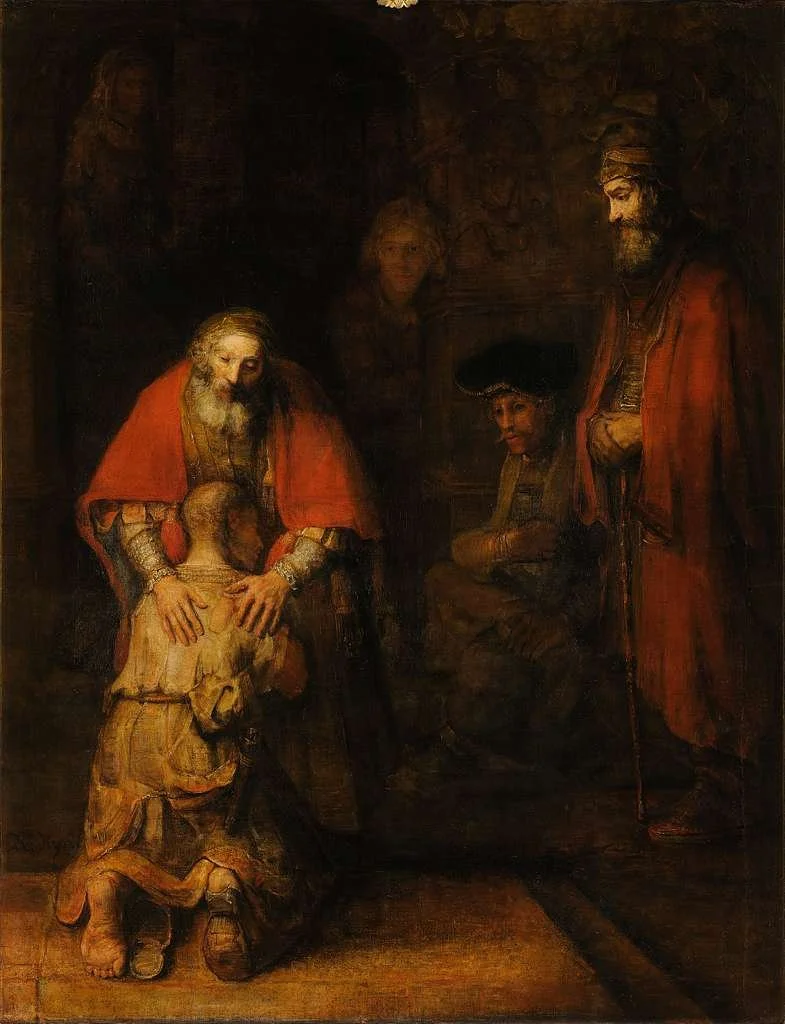
Back in the 1660s, toward the end of his life, the Dutch artist Rembrandt painted one of his most iconic works called The Return of the Prodigal Son. I have a reproduction of this painting in my study, so I look at it everyday. Part of the brilliance of the painting is that Rembrandt makes the central point of the painting to be between the younger son and the older son. It’s just darkness — what Henri Nouwen calls the “tension of the dark middle.”
The idea is that when you look at the painting, you’re torn between both sons, and the tension is that you have to choose which son you identify with the most — the younger to the left or the older to the right?
And I don’t know if Rembrandt meant this or not, but that tension is precisely what Jesus is creating when he tells the story. Luke 15 opens like this, verse 1:
Now the tax collectors and sinners were all drawing near to hear him. 2 And the Pharisees and the scribes grumbled, saying, “This man receives sinners and eats with them.” 3 So he told them this parable …
Inductive Bible study again:
What people were drawing near? … tax collectors and sinners.
Who is it who grumbled about that? … the Pharisees.
Who did Jesus tell the parable to? … them.
That is “them” as in a mixed crowd. Jesus was talking to tax collectors and sinners, and Pharisees and scribes, and he told them these three stories: a hundred sheep, one lost; ten coins, one lost; two sons, both lost — except we don’t know the older son is lost until we see how he responds to the younger son’s return.
Up until verse 25, how do you imagine that the mixed crowd of sinners and Pharisees were hearing Jesus? Do you think the Pharisees in any way could have seen themselves in the younger son? No way!
The Pharisees were feeling pretty good.
Seeing the Older Son
This older son, in verse 25, was in the field. Of course he was. He was working. But as he came closer to the house he heard the music and dancing, and he asked one of the servants what was going on. He said, verse 27,
“Your brother has come, and your father has killed the fattened calf, because he has received him back safe and sound.”
And here’s the suspense, it’s that pause between verse 27 and 28 … verse 28,
“But he was angry and refused to go in.”
And his anger at the news is meant to be contrasted with the compassion of the father. The father felt compassion and ran toward the younger son; the older son felt anger and withdrew.
The father even came out and entreated him. He wants to save both his sons, but look what the older says, verse 29:
“Look, these many years I have served [slaved for] you and I never disobeyed your command, yet you never gave me a young goat, that I might celebrate with my friends. But when this son of yours came, who has devoured your property with prostitutes, you killed the fattened calf for him!”
You hear that? What a victim! I have worked like a slave for you! I have always obeyed you! You never cooked a goat for me! You never threw me a party!
Now if we stopped here, he’d be whining. But he keeps going and basically frames the whole thing as if the father is unjust. I did all this for you, and you didn’t give me a goat. Your son did these horrible things, and you have him a goat.
See, he’s been living in Do-Have-Become:
All this doing, he thinks, and I deserve better!
He makes himself a victim over a goat … but we remember verse 12. The father divided his property between them. This older brother actually owns the whole farm. Why is he whining about a goat? Doesn’t he know what it means to be a son? You own the farm, bro. It’s yours.
That’s exactly what the father tells him in verse 31:
“Son, you are always with me, and all that is mine is yours.”
See, the older son had been living as if he were a slave of the father, not a son. His False Self was built by achieving instead of receiving; grueling work instead of wild grace. He literally stood on an abundance of riches, but his self-righteousness had blinded him to it.
In Rembrandt’s painting, the older son is dressed nearly identical to the father. They’re both wearing a red cloak, “like father, like son.” But in this story, the older son never calls the father his father, while the younger son only calls the father his father … so the irony is that the son who has been closest to the father this whole time is actually the one who is most lost. The older son didn’t travel to the far country, but he’s far removed from living as a true son.
But, just as the father saw the younger, felt compassion, and ran toward him, the father goes out and entreats the older. And look what he calls him in verse 31: “Son.”
If only this older son could see himself the way the father sees him, instead of chasing his False Self. If he would only just listen to the father, that is how he would recover his name.
And that goes for all of us, whether you see yourself as the younger son or the older. I look at this painting everyday, and I find myself in both. The real question, though, is: What does the old man say?
He calls them both his sons. … Can you hear that?
Listen to the Old Man
Can you hear God calling you his son louder than everything else?
Can you hear it louder than the False Self you’ve pursued? Or louder than the pain left to you by your earthly father?
Nouwen puts it like this:
At issue here is the question: “To whom do I belong? To God or to the world?” Many of my daily preoccupations suggest that I belong more to the world than to God. A little criticism makes me angry, and a little rejection makes me depressed. A little praise raises my spirits, and a little success excites me. It takes very little to raise me up or thrust me down. Often I am like a small boat on the ocean, completely at the mercy of its waves. All the time and energy I spend in keeping some kind of balance and preventing myself from being tipped over and drowning shows that my life is mostly a struggle for survival: not a holy struggle, but an anxious struggle resulting from the mistaken idea that it is the world that defines me.
As long as I keep running [in this search] I give all power to the voices of the world and put myself in bondage because the world is filled with “ifs.” The world says: “Yes, I love you if you are good-looking, intelligent, and wealthy. I love you if you have a good education, a good job, and good connections. I love you if you produce much, sell much, and buy much.” There are endless “ifs” hidden in the world’s love. These “ifs” enslave me, since it is impossible to respond adequately to all of them. The world’s love is and always will be conditional. As long as I keep looking for my true self in the world of conditional love, I will remain “hooked” to the world — trying, failing, and trying again. [Hear that: Do-Have-Become]. It is a world that fosters addictions because what it offers cannot satisfy the deepest craving of my heart.
The younger son searched for his true self where it can’t be found; the older son searched for his true self how it can never be earned.
The younger son said his father should treat him as a slave; The older son told his father he already worked for him as a slave.
But both sons, if they are going to recover their name, must listen to the Father. He calls them sons.
He calls you son. His beloved son. We start there.
That’s the first sentence of your name. What’s in the right column needs to get to the top of the left column …
“My name is [your name], a beloved son of God…”
Do you men believe that?
When you recover your name, that’s when you start to redeem your wounds.
2. Redeem your wounds
I said last night, and I’ll say it again, every man carries a wound. To be a man is to have been wounded. And this, of course, is part of every great story.
In Greek mythology, this is all over the place, but we’re most familiar with Achilles’ heel or the homesickness of Odysseus.
According to the mythologist Robert Bly, the name Odysseus means “thigh wound” — which is symbolic because in ancient literature the thigh was seen as the symbol of masculine strength and virility. So a wound to the thigh is a wound to the masculine identity.
Which, by the way, that’s most likely what was going on when Jacob wrestled with God in Genesis 32. God “touched his hip socket” (verse 25), but that word for hip socket is yārek which means thigh or loins. He had a thigh wound. So Jacob, who had all these sons, the bearer of God’s promise to Abraham, he walked with a limp in the precise area necessary to God’s promise. That wound was not arbitrary to his purpose, but it was in the same picture.
That’s every good story — Bruce Wayne, Harry Potter, Frodo Baggins — they all tell us about wounds. We could come up with all kinds of examples.
Wounds are part of good stories.
So why do we as men try to hide, rename, or fix our wounds? We try to do everything other than face our wounds. In fact, that’s often why we busy ourselves with others’ problems. Sometimes it’s why men get married and think they’re good at it — we’d rather carry our wives’ pain than face our own.
I’ve Been There
I’m not saying this theoretical. I’ve been there. In 2017, my wife entered into a depression and started counseling, and I went to every session. Every week, every other week, for three years, I was there as the sounding board, a conversation partner. I carried her pain with her, for her. I was a great husband … and then she got better! … and I got lost.
All this time of focusing on her pain, I ignored my own, because it’s easier that way.
One writer says that men can be proud to pick up the pain of others, and especially women’s pain, but it’s actually a form of passivity. And that’s the irony: We can think of ourselves as being sacrificial and defending our home, and muscling through, but we’re actually being passive to our pain by turning our heads and distracting ourselves, but it will eventually catch up with us in a crisis.
The truly masculine response to our wounds (the Be-Have-Do response) is not to hide, rename, or fix our wounds — but it’s to own them and redeem them (or better said, allow them to be redeemed by God). This means they are part of your story, but they don’t dictate who you are. We saw that example last night with Maximus.
And when you hear me say wounds, a lot of different things might come to mind for you. We’ve experienced wounds of varying degrees. Some of you have been through hell, as a kid or maybe later in life. The pain is deep. The scars are real. But one thing that’s true about all of our wounds is that none of them were fatal wounds, because we’re all here. And if you’re here, God’s not done with you. He’s writing your story, which includes that pain, and he can redeem it.
Male Wombs
Again, this an ancient idea. It’s in all the great stories. And Robert Bly says the mark of true transformation is that a man’s wound becomes a male womb.
Male wounds become redeemed as male wombs.
And that sounds super weird, but his metaphor is from Greek mythology. Zeus rescued his unborn child, Dionysus, by cutting a womb into his own thigh. He carried the child until she was born. Literally, he made a womb through a wound.
From this injury to himself comes life and fruitfulness. Isn’t that interesting?
Do you think that’s echoing something deep in the universe. Isn’t this at the beginning of man’s story? It’s in Genesis. God creates Eve, the mother of all living, from the side of Adam. He made a womb from Adam’s side and from it he brought life. We saw that same theme with Jacob. He walked with a limp, but from him came the nation of Israel. But ultimately, we find this theme in what Jesus did, and in the ultimate sense.
With no sin to bear of his own, he took our sin, and he was wounded for it. He was pierced for our transgressions, crushed for our iniquities (Isaiah 53:5). The apostle Peter, quoting Isaiah 53, says:
“By his wounds you have been healed” (1 Peter 2:24).
From that wound of Jesus came a womb that created many brothers…
God said:
Isaiah 53:11,
“Out of the anguish of his soul he shall see and be satisfied; by his knowledge shall the righteous one, my servant, make many to be accounted righteous, and he shall bear their iniquities.”
Romans 8:29,
“For those whom God foreknew he also predestined to be conformed to the image of his Son, in order that he might be the firstborn among many brothers.”
Hebrews 2:11,
“For he who sanctifies and those who are sanctified all have one source. That is why he is not ashamed to call them brothers.”
God knows how to bring good from wounds, even the worst of wounds, and that is our salvation. And if he can do it through the cross, he can do it in your life. He can make the hurt not just heal, but bear fruit. That place of pain can become a fountain of life.
And it’s necessary if we’re going to rise to the moment.
3. Rise to the moment
Recover your name — stop constructing a False Self and actually BE who God made you and saved you to be. You are his son. That is your identity to work from.
Redeem your wounds — stop being passive to your pain, but acknowledge it and allow it to be redeemed by God.
And that’s when we find ourselves as whole men in a world that’s broken. We’re men who have come home, who keep coming home … until eventually we grow to become fathers. I don’t mean physically, but spiritually. We become spiritual fathers, which is what we should all aspire to.
The father is what The Story of the Lost Sons is really about. Our sonship is the display of God’s mercy and grace, and his joy.
It’s interesting that in Luke 15, Jesus finishes the story and we still don’t know what the older son does. Jesus doesn’t tell us. The younger came home, and story ends with the older son receiving an invitation. But what is clear is that the father is throwing a party for whoever wants to come. The last verse, verses 32, the father says:
“It was fitting to celebrate and be glad, for this your brother was dead, and is alive; he was lost, and is found.”
That’s the heart of a father that our moment needs.
The Current Moment
I’ve been so discouraged the past two weeks, by many things, by the assassination of Charlie Kirk, and by the division that still exists in our country. The culture war still rages, and the in-fighting is just getting worse, and I do believe demonic forces are at work, and I do believe that it’s a battle between good and evil, and we need moral clarity. Christian men must rise to the moment, but what that does not mean is that we are overcome with hatred.
Psalm 97:10 says,
“O you who love Yahweh, hate evil!”
But that doesn’t necessarily mean hate people, and it especially doesn’t mean hate deceived people. That is most of who’s out there — people swept away in the darkness, people who are lost.
In our hatred, we want to fight them — Batten down the hatches to our institutions; secure the walls; take down the libs — but the heart of the father is to invite them home. To show them the way home. And they may not come, they may refuse to, but that means they’re missing the party.
That’s how I’d put it in a nutshell: our moment needs fathers who throw good parties.
That doesn’t happen without men being their true selves, beloved sons of God — never less than sons, but sons who grow up to become spiritual fathers.
Spiritual fathers who possess not contempt, but courage; not malice, but love; not rage, but joy. We’re happy to be home, and eager to help others find their way back, too.