
Increased Clarity for Increased Health
[The following was delivered at a CGL Summit on June 23, 2019].
Thanks to everyone for being here. Let me start by giving you an overview of what we’re planning to do over the next 90 minutes. We want to work toward two outcomes: increased clarity and increased health — and we think that the former leads to the latter.
We want to keep repeating, as much as we can, how Community Groups work at the level of structure. How do Community Groups operate in light of our church’s mission? What is the role of Community Groups in the big picture? What parts do each of you have?
I think that the more clarity we can get on that, the more on the same page we become, that is going to set you up well to be an effective CG leader.
So the plan today is for me to talk clarity. I’ll give an overview of the structure, with some newer angles that might be helpful, and Mike will follow that with some practical, on-the-ground encouragement for how you lead. That part will be interactive because we are going to divide up into our clusters.
A Prayer for Our CGs
Let’s pray: Father, thank you for your grace to our church, and thank your for our Community Groups and these leaders. Father, thank you for systems and structures, and for their place in your household. We learned from 1 Timothy 5 that systems exist to protect the things we care about, and that goes for these groups. We care about discipleship and community and evangelism and welcoming others as you, Father, have welcomed us, and so we have these groups, these little networks of relationships, and I ask for your blessing on these groups, on what we’re trying to do. Give us renewed energy as we move through the summer and into the fall, and use this time today toward that end. In Jesus’s name, amen!
Clarity on Community Groups
I want to talk about three things: Purpose, Variation, and Evangelism
The Purpose of CGs
Overall, the purpose of Community Groups is two-fold: first, the groups are strategic for how the pastors track and shepherd our covenant members; second, the groups are a step in our discipleship process as they welcome and connect new people into the life of Cities Church. So in two words, the purpose of CGs is Shepherding and Connection.
Shepherding
This is not very different from how we have talked before, but we want give more details into how the groups really function. And one of the things we’ve not talked a lot about it how they are helpful in our shepherding work as pastors. The clusters are especially helpful in this (see Image 1).
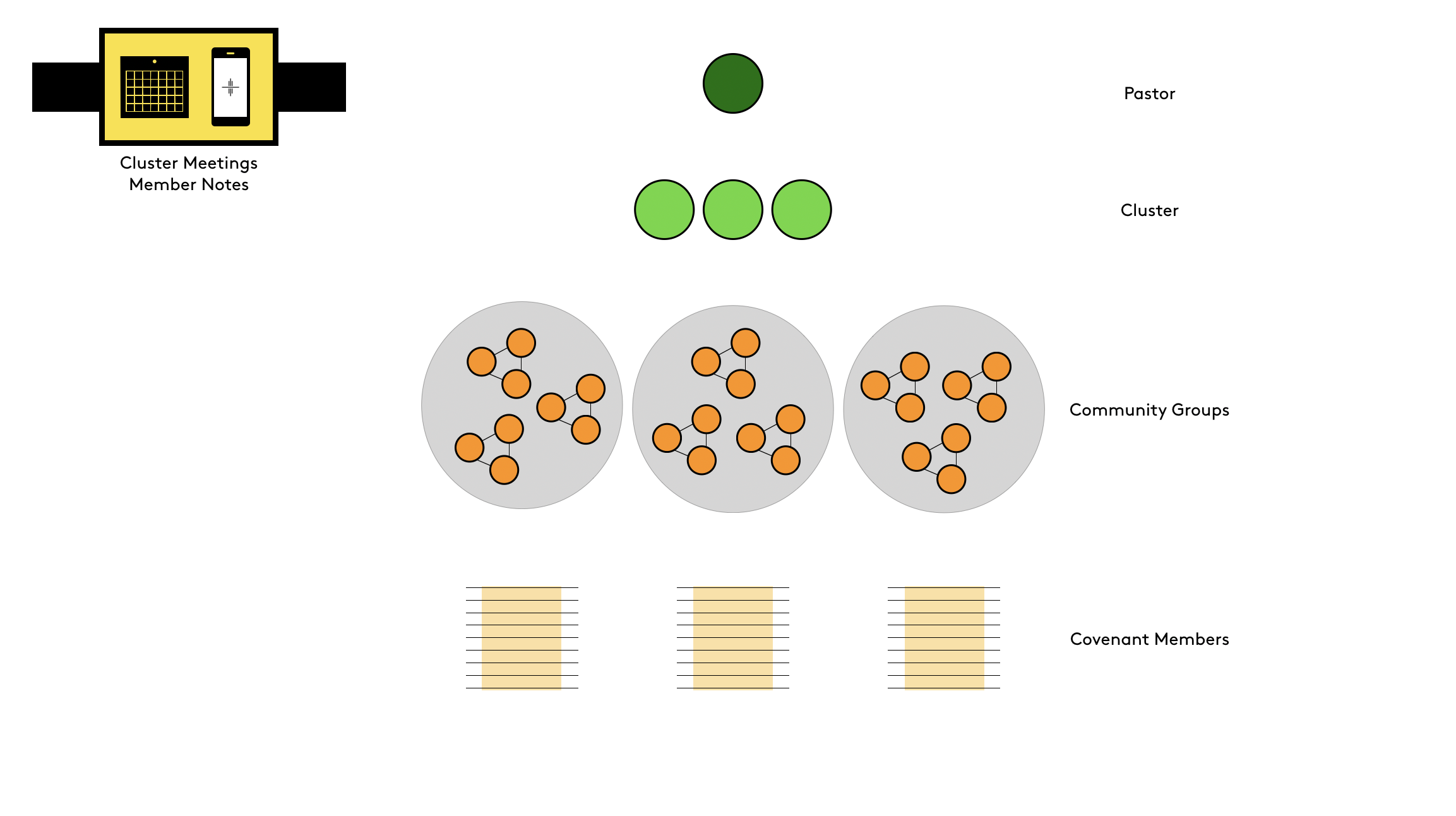
Image 1
We want you to know how the pastors are thinking about our CGs and our clusters, and this is also how you, as CG leader, are assisting the pastors. Leading Community Groups is a diaconal role because you are assisting the pastors in our shepherding care of our members.
Connection
Now, when it comes to Connection, we have typically said that CGs are for outreach — and they are — but we’ve not really filled in exactly how, and it’s important we do that since there are variations among groups (I’ll get to that in a minute).
But in terms of how you should think about your group as the structural level, I think Robert Coleman is really helpful.
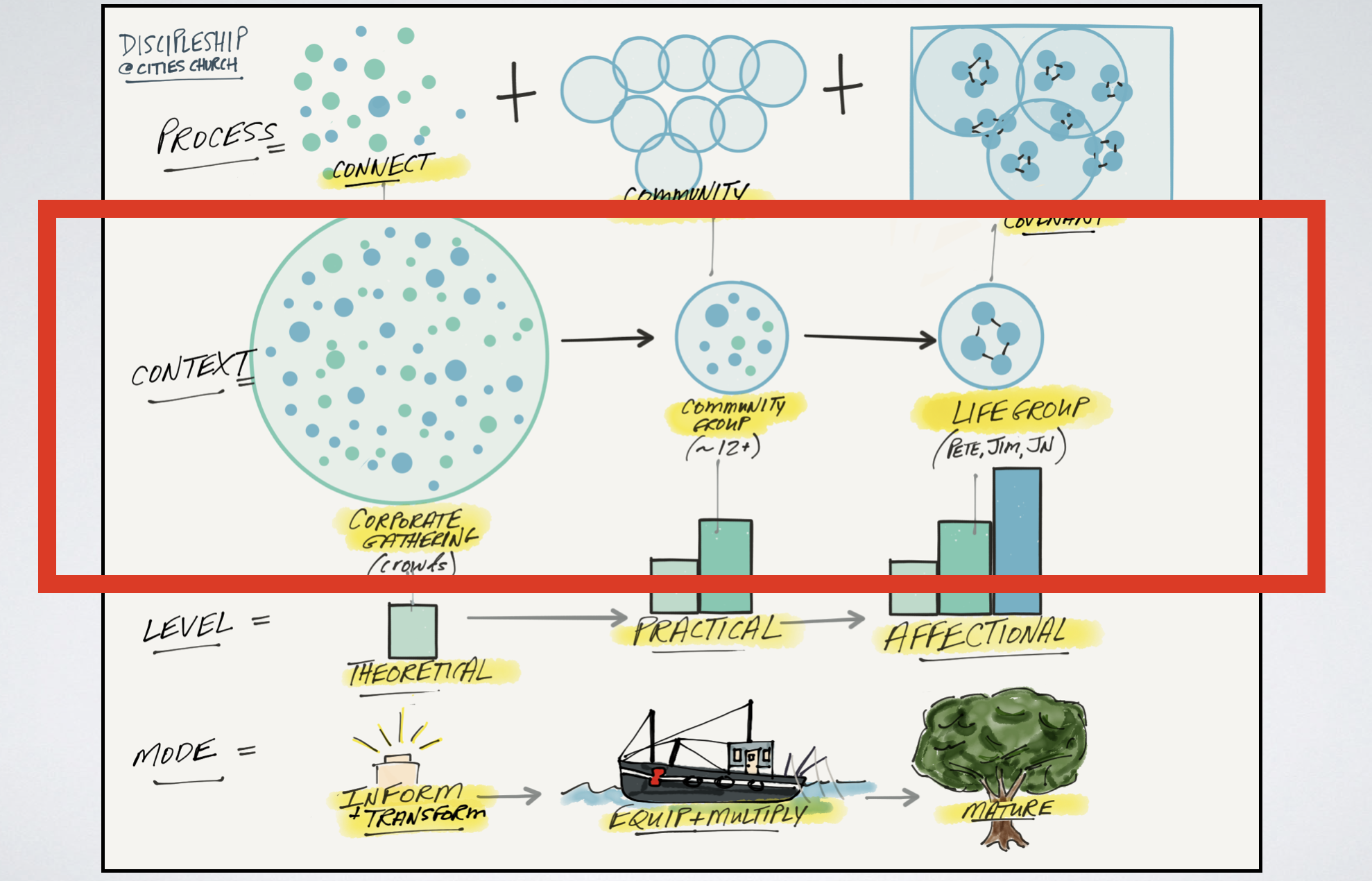
Image 2
This is a good illustration from Coleman. It’s good for our imagination (see Image 2). Colemans says that Jesus, in his ministry, had mainly three audiences of different sizes and commitments. There were the crowds, the twelve disciples, and then the huddle of Peter, James, and John. These three audiences line up nicely with our discipleship structure:
the crowds are open to anyone, whoever shows us to hear Jesus teach; just like our Sunday mornings. We come here to worship God, but everyone is welcome
the twelve disciples are those that Jesus called for more focused discipleship, and he was doing two things: he was shaping them as disciples and he was equipping them to be disciple-makers;
the huddle of Peter, James, and John was the tightest group; they received the most investment, the most time; they saw the transfiguration
Well, I want to promote that the leading metaphor for our Community Groups be the twelve disciples. I know some groups are larger than twelve, and some have less, but you should think of your group as a group of disciples following Jesus together, being shaped as disciples and equipped as disciple-makers, and you, as the leader, are the lead disciple in that group. You’re all following Jesus, but as the leader, you’re the leading follower.
Let this be the first place your imagination goes when you think about your group. If you ask: What is a Community Group? How does this work? Think: we are a group of disciples following Jesus, and I’m the lead follower.
The Variations Among CGs
Every group is different: CGs are made up of different people in different parts of the cities, and those differences are going to affect the group. One of the biggest influence is kids. Groups with a lot of kids are going to look differently, and that’s okay. We want to give groups the flexibility and freedom to be different. We’ve tried to identify these differences in three types (see Image 3).
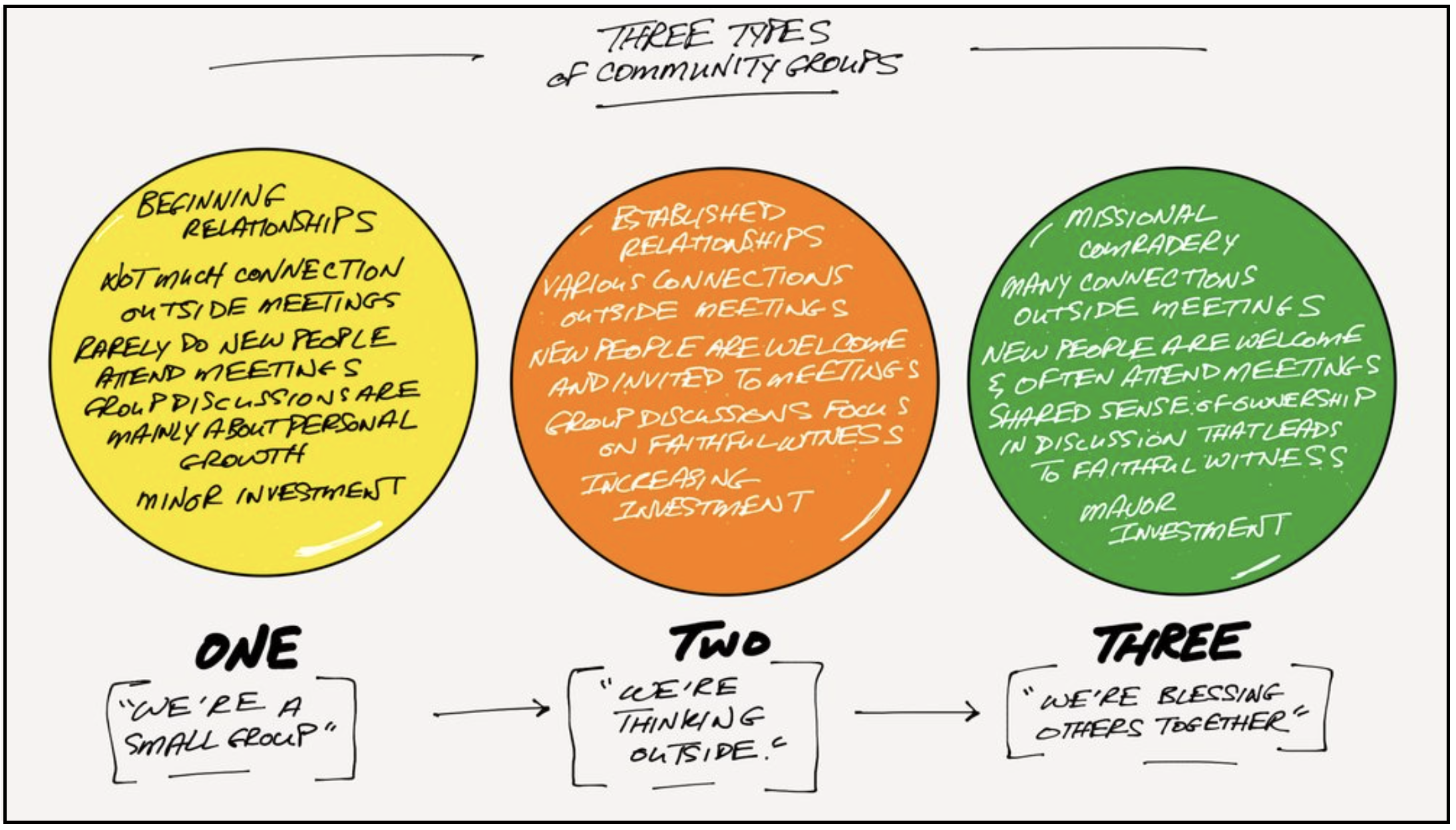
Image 3
We are calling these types, not levels, because it’s okay if you’re a Type 1. We want group leaders to be able to identify where their group is, and lead your group where it’s at.
Type 1 is more like a small group. These are smaller groups, and there is a relational focus in the group, and they don’t tend to grow fast.
Type 2 is a group that has a strong relational culture, and they are good as welcoming others, and they so they grow easier.
Type 3 is a more missional group that really collaborates on how to be witness, on making new relationships, and on welcoming new people.
There is overlap in these three types; none fit perfectly, but our 23 groups are different and we want to own those differences, and support each group in the purpose of Shepherding and Connection.
Evangelism through CGs
Now, where does these leave evangelism? Community Groups are the outreach arm of our mission to make disciples. It’s where we’re are seeking the good of the Cities and looking beyond ourselves to be a witness in our cities. How does evangelism work in Community Groups?
And a fresh way to explain this is that evangelism is a calling on Christians, not groups. Whole groups don’t share the gospel for people, but people share the gospel with people. So we want to equip our membership in personal evangelism as part of discipleship. Growing in Christlikeness, and being shaped as disciples, will include learning how to share the gospel.
The language tweak goes like this: rather than saying that Community Groups are for evangelism, Community Groups are for discipleship, and as disciples are formed and grow, those disciples evangelize — and the Community Group is a readymade network of relationships to welcome would-be and new disciples.
Christians share the gospel, and your Community Group is a network for Connection. Your Community Group is a web of relationships that welcome people new to Jesus or new to Cities Church.
One of the things this means is that we want to do whole church evangelism equipping. We can train our whole membership in how to do personal evangelism, and your Community Group is a tool that helps you do that.
Summary
So Purpose, Variation, and Evangelism
The purpose of groups are for Shepherding and Connection;
every group is different and that’s okay,
and we want to equip our members for personal evangelism of which Community Groups are a tool